

Time:24-26 August, 2026
Charge: RMB 2,800
The expenses for filed trip include accommodation, transportation, and necessary entrance fees
Tips
-If the registrants are less than 10, the filed trip may be cancelled
-The attendees should be gathered in Nanjing
-The field trip will conclude after lunch on August 26. Estimated drop-off times for transportation hubs are as follows: 15:00 Qianshan High‑Speed Railway Station, 17:00 Hefei Xinqiao International Airport, 18:00 Nanjing Lukou International Airport
Contact
Prof. Renxu Chen, University of Science and Technology of China
Email: chenrx@ustc.edu.cn
The introduction offield trip
The Dabie orogen in east-central China is a typical continent-continent collisional orogen that was produced by northward subduction of the South China Block beneath the North China Block in the Triassic. It contains not only one of the largest-exposed(~30,000 km2) and best-preservedUHPmetamorphic terrane in the world,but also one of the areas thathaveintense magmatismin the post-collisional stage after theformation of UHP metamorphic rocksby the continentaldeep subduction. This field trip focuses on UHP metamorphic rocks with index minerals (such as coesite and microdiamond) in the Triassic and post-collisional granites in the Early Cretaceous.The UHPeclogite, jadeite-quartzite, biotite paragneiss and marble are enclosed as pods and layers within the regional granitic orthogneiss.All these rocks underwent in situ UHP metamorphism during the continental collision in the Triassic.Therefore, a huge amount of the crustal rocks wassubducted to subarc depths of 80–160 km for insitu UHP metamorphism.Post-collisional magmatism from partial melting of the UHP metamorphic rocks is prominent in the Early Cretaceous.
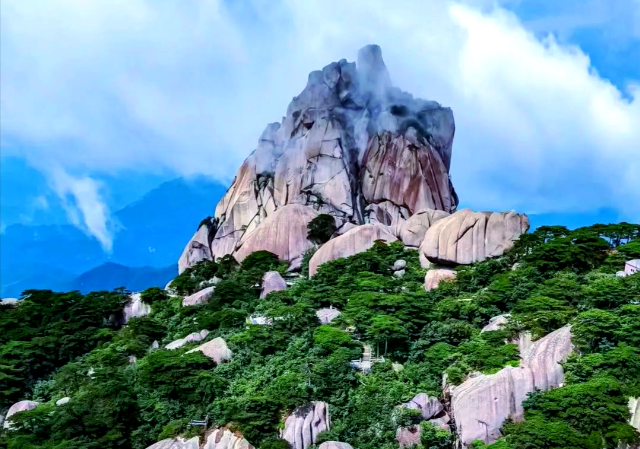
Photograph of the Tianzhu Mountain.


